THE MYSTERY OF “OLD” SHERBURNE’S GOLD – 1857
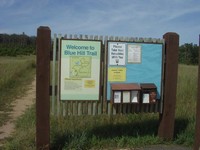
There is no authentic record of the early settlers of Blue Hill Township. Presumably it was settled about 1856. It was organized in 1877, having previously been a part of City of Baldwin. It is named because of a lone hill, called Blue Mound, which rises about 75 feet above the surrounding country and may be seen from a great distance.
There is record of a town called “Grotan,” which was laid out in 1857, but there is no evidence of such a town today.
Joshua R. Brown settled on Section 12 in 1861. Miss Isadore Marshall was the first school teacher . The first officers of the town were: J.R. Caruthers, L.H. Pratt and John Kaliher, supervisors; Thomas E. Brown, clerk; J.R. Brown and J.R. Caruthers, justices of the peace; R.B. McArthur, assessor; John Rogers, William Marsh and Frank Northway, constables.
For the past one hundred and twenty years, an intriguing mystery has surrounded the Blue Hill Township area of Sherburne County. It involves two separate treasures of gold buried in almost the same spot. The puzzle has never been solved and as far as we know, the gold is still hidden there to this day.
Here is the story which has been handed down through the generations: Back about the time Sherburne became a county in 1857, there lived a colorful character called “Old Sherburne” in what is now Blue Hill Township.
Nobody knew anything about him or even where he came from. He lived as a secluded hermit in a dugout earthen home, and he wore self-made clothing formed mainly from animal skins. That’s really about all we know of the man except for one other thing: he had a lot of money, and it was all in gold coin.
“Old Sherburne” was not your typical grumpy old hermit. On the contrary, he was a friendly warm-hearted guy and when he found another person in need, he was very generous in either giving or loaning them money. According to the story, he helped many people in this way and never really worried about whether he would be repaid. “Old Sherburne” died in 1882 and was buried in Blue Hill Cemetery, originally called Galbraith Cemetery. Before he died, it is believed, he buried his treasure of gold coin somewhere in or near the blue hill glacial deposit mound in the township.
There is substantiation to “Old Sherburne’s” wealth. Shortly after his death, a brother who had been located in Indiana made the trip to Blue Hill Township. His purpose was to claim personal affects and to retrieve the gold coin. According to the brother, “Old Sherburne” had sold out his interest in a business back East many years before. The day after the sale, Sherburne disappeared with more than 40 thousand dollars in gold coins. The brother spent a full month searching for Old Sherburne’s gold, but he never located it.
From: “There’s Gold in Them Thar Hills” by Sherburne County Historical Society
GOLD ON THE ILIFF FARM – 1904
Gold fever hit the county during the year when a small amount was discovered on the old Iliff farm in Livonia. When it was assayed it amounted to only $3.50. The news, however, sent many county residents out with shovels hoping to hit a lode.
(From: The Growth of Sherburne County 1875 – 1975 by Sherburne County Historical Society – page 194)
GOLD COIN IN THE WALL – 1915
This interesting story was told to Lester Kriesel by Lawrence Meyers, an old-timer, who was a neighbor to his dad. The house his dad bought in Zimmerman was built out of concrete blocks in 1915.
When the blocklayers were building the north wall, one of the blocklayers reached into his pocket and took out a gold coin. He tossed the coin into one of the hollow blocks and covered the coin with cement.
The blocklayer said that someday when they tear down this house, they would wonder who put this gold in the wall. Allegedly the gold coin is still there.
GOLD IN BLUE LAKE
Blue Lake is an arrow’s shot east of City of Baldwin.
Blue Lake supposedly got its name from a Frenchman whose last name was Bleau. He was a trapper who lived in a log cabin on the southwest corner of the lake. People in the area referred to the lake as Bleau’s Lake. Later common usage confirmed the name – Blue Lake.
At the north end of Blue Lake was Bastion Lake (aka Walker Lake). Some residents say a channel was dug to connect the two lakes. Others recall a dam being built on the north end of the lake which remains to this day. This raised the lake level and formed a larger lake with a slight narrowing by the channel.
Pat French, a resident, remembers her dad telling her (she was about 9 years old) about a man losing a pouch of gold coins in the lake. As she recalled the story, the man decided to walk across this channel at a narrow place.
The ice was thin and he broke through it. During the struggle to get out of his predicament, he dropped the pouch of gold coins into the lake. He searched for the coins in the 3 feet of water, but the lake bottom was covered with mud and weeds, and he never found it.
No one knew how many gold coins he had that day, but they are allegedly still resting on the bottom of Blue Lake.
There is another story of loosing gold in Blue Lake in the early 1920’s. Two men built a fish house large enough to include bunk beds and set up light housekeeping. They planned to spend the winter fishing commercially. After catching a load of fish, they would take it to the twin cities and sell it. One man was resting on his bunk. A signal told him he had a fish on his line. He rolled over to grab his line and $500 worth of gold coins came tumbling out of his bib overalls. Most of the coins fell through the ice and into the lake. Allegedly they have never been found.
(From: Popular versions of "old timers" stories by Pat French, Rodney Kriesel, etal.)
THE LOST PAYROLL – 1862
The gold mystery of Blue Hill gets even better. There could be a second treasure of gold buried in the same area. According to another story, in 1862 a troop of soldiers where transporting an army payroll from Fort Snelling to Fort Ripley. Near Blue Hill Township, they were informed by a dispatcher of a nearby Indian uprising and were ordered to bury the payroll and proceed immediately to Mankato. Only the paymaster and one other soldier knew where the payroll was buried, and both were later killed. The treasure’s location remains unknown.
There is also this slightly different version of the Fort Snelling – Fort Ripley gold story. It was told to the writer by Aaron McDonald of Zimmerman in 1978. His version indicated that the soldiers had made contact with some Indians just north of Elk Lake along Battle Brook. This would place the location of the event in City of Baldwin.
It was getting dark when the soldiers buried the two saddlebags of gold coins under the roots of an oak tree. The soldiers whipped the packhorse, sending it off into the night towards Fort Ripley. The Indians thought the soldiers were escaping and followed the packhorse. Meanwhile the soldiers escaped and returned to Fort Snelling.
A fire burned through the area later that year and when the troop came back in the spring they were unable to find the gold.
No one can confirm the absolute truth of the above legends. The information on which they are based was handed down verbally through several generations of people. But there appears to be sufficient consistency to believe that they are more fact than fiction or imagination. There probably was a sizable amount of gold buried in Blue Hill or City of Baldwins and, from what we can surmise; it is probably still there today.
From: "There's Gold in Them Thar Hills" by Sherburne County Historical Society